
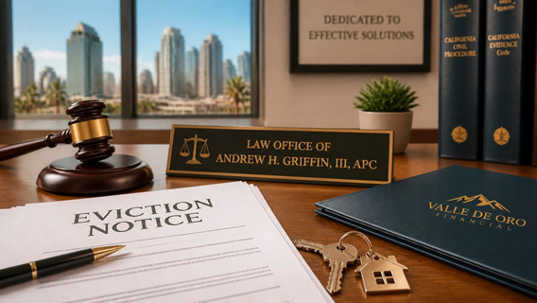
If you are a small business owner in San Diego, the roof over your business is just as important as the one over your home. Receiving a legal eviction notice, such as a 3-day or 10-day notice, is a highstakes moment that can feel overwhelming. The notice can be a precursor to an unlawful detainer lawsuit. An unlawful detainer is the court case a landlord may file only after the notice period expires and the tenant has not complied or moved out. You may be worried about your inventory, your employees, and the years of hard work you’ve poured into your company.
The landscape of commercial evictions in California has shifted significantly with the arrival of new laws like SB 1103 and AB 2347. These updates were designed to give smaller tenants a fighting chance, but they come with technical requirements that you must navigate perfectly to protect your rights.
At the Law Office of Andrew H. Griffin, III, APC, we have spent over 40 years helping the San Diego community navigate these complex legal waters. Because Andrew Griffin is both a California-licensed real estate broker and an experienced attorney, our firm offers a unique dual perspective that most traditional law firms cannot match. Whether you are a landlord trying to follow the new rules or a tenant fighting to stay in your space, you deserve a guide who understands both the law and the market.
What is the New 10-Court-Day Response Rule?
For years, commercial tenants in San Diego only had five days to respond to an unlawful detainer summons and complaint. In the world of business, five days is barely enough time to find a file, let alone hire a commercial eviction lawyer and prepare a defense.
Under the new rule (Assembly Bill 2347), you now generally have 10 court days to file a written response with the court after you are served with the actual unlawful detainer lawsuit papers. This is acritical distinction. A landlord’s legal eviction notice, such as a 3-day notice or 10-day notice, is a prelawsuit demand. The 10-court-day response deadline does not start when that notice is served. It starts only after the landlord files the unlawful detainer case and you are served with the court summons and complaint. While this is an improvement, it is still a remarkably tight window.
It is important to remember:
- Court days are not calendar days. Weekends and court holidays do not count toward your 10-day limit.
- The 10-day rule applies to the lawsuit, not the notice. A legal notice gives you a deadline to pay, perform lease obligations, or vacate. The unlawful detainer is the separate court action that may come later if the issue is not resolved.
- Missing the deadline is critical. If you fail to file a response within those 10 court days after service of the summons and complaint, the landlord can request a "default judgment." This allows them to move quickly to obtain a writ of possession and have the Sheriff remove you from the property.
- The response must be formal. You cannot simply call the landlord or send an email. You must file a valid responsive pleading, such as an Answer or a Demurrer, with the San Diego County Superior Court.
If you have been served with unlawful detainer court papers, the clock is already ticking. You should contact a San Diego eviction attorney immediately to ensure your response is filed correctly and on time.