

If your San Diego tenant has stopped paying rent or violated the lease, it is normal to feel pressure to regain possession quickly. The first step, however, is usually not filing an eviction lawsuit. In most situations, you must first serve the tenant with a legally sufficient notice.
A 3-Day Notice to Pay Rent or Quit is a pre-lawsuit demand. An unlawful detainer is the court lawsuit that may follow if the tenant does not pay, correct the violation, or move out. Understanding the difference can help you avoid delays, rejected filings, and unnecessary expense.
What is a 3-Day Notice to Pay Rent or Quit?
A 3-Day Notice to Pay Rent or Quit is a written demand that gives a tenant an opportunity to pay qualifying rent or leave the rental property. It is not a court document, and it does not mean that a judge has ordered the tenant to move.
For a nonpayment case, the notice generally must identify the rent claimed to be due and explain how the tenant can pay it. The notice must give the tenant a legally sufficient opportunity to comply before you file an unlawful detainer.
California also recognizes other types of notices, including:
- A 3-Day Notice to Perform Covenant or Quit for certain curable lease violations.
- A 3-Day Notice to Quit for certain violations that cannot be corrected.
- Longer termination notices for some month-to-month tenancies or no-fault situations.
The correct notice depends on the reason for the proposed eviction, the lease, the property, the tenant’s length of occupancy, and whether the California Tenant Protection Act or a local rule applies. A notice that is appropriate for one San Diego rental may be defective for another.
The California Courts’ notice-type guidanceemphasizes that eviction notices are not court forms and that mistakes or missing information can cause a landlord to lose an eviction case.
When does an unlawful detainer begin?
An unlawful detainer begins when you file a complaint in court seeking possession of the property. The complaint states the legal basis for the eviction and the facts supporting your claim.
The tenant must then be properly served with the summons and complaint. Service of those court papers formally gives the tenant notice of the lawsuit and starts the deadline to respond. The tenant’s response deadline is separate from the deadline in the earlier 3-Day Notice.
The general sequence is:
- Identify the legal grounds for ending the tenancy.
- Prepare the correct notice.
- Serve the notice using a legally permitted method.
- Allow the full notice period to expire.
- Determine whether the tenant paid, corrected the problem, or vacated.
- File an unlawful detainer complaint if the tenant remains without resolving the issue.
- Properly serve the summons and complaint.
- Proceed through the tenant’s response, court hearings, judgment, and, if necessary, a writ of possession.
The San Diego Superior Court’s landlord/tenant pageexplains that an unlawful detainer is the civil action a landlord files to try to evict a tenant who allegedly no longer has the right to remain. San Diego unlawful detainer actions are filed through the court’s designated Central Division process, even when the rental property is located elsewhere in San Diego County.
How are a 3-Day Notice and an unlawful detainer different?
The simplest distinction is that the notice is the demand, while the unlawful detainer is the lawsuit.
|
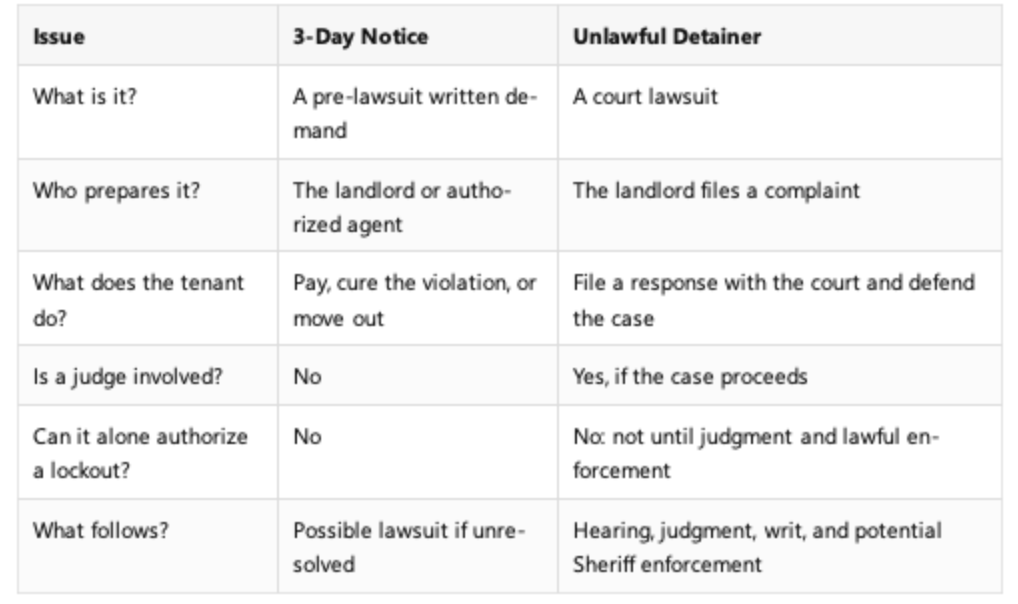
A 3-Day Notice does not permit a self-help eviction. You generally cannot change the locks, shut off utilities, remove belongings, or physically force the tenant out. If you prevail in court, the Sheriff: not the landlord: enforces the writ of possession. How should you calculate the three-day period?You should calculate the deadline carefully and document the service date. The day of service is generally not counted as the first day. The counting rules exclude Saturdays, Sundays, and judicial holidays for a 3-Day Notice to Pay Rent or Quit. Because the final deadline may depend on the method and date of service, avoid relying on a quick calendar calculation. Before filing, confirm:
The notice should communicate the timing clearly enough that an ordinary tenant can understand when the period starts, when it ends, and what must happen before the deadline. If the notice leaves the tenant guessing, the problem may later become a defense to the unlawful detainer. How does Eshagian v. Cepeda affect your notice?The California Court of Appeal’s decision in Eshagian v. Cepedareinforces that clarity matters. The court held that a 3-Day Notice to Pay Rent or Quit was defective where it did not clearly explain when and how the tenant had to pay and that failure to pay could result in loss of possession. The practical lesson for San Diego landlords is not simply to use the words “three days.” Your notice should make the compliance process understandable. In particular, review whether it:
A defective notice can undermine the entire case. Even if rent is genuinely unpaid, a court may dismiss an unlawful detainer if the required preliminary notice was inaccurate or legally insufficient. Eshagian therefore makes careful drafting and review especially important before you take the next step. Which service mistakes can delay your eviction?Improper service is one of the most common reasons an eviction case becomes vulnerable. A landlord may have a strong payment history and a valid lease, but still face dismissal if the notice cannot be proven to have been served correctly. Depending on the circumstances, permitted service may include personal delivery, substituted service, or posting and mailing. The method must comply with California law, and you should preserve a detailed proof of service. Common mistakes include:
Keep the lease, rent ledger, payment records, photographs, communications, notice, and proof of service together. That file may become important evidence in San Diego Superior Court. What should you check before filing an unlawful detainer?Before filing, confirm that the tenant’s failure to comply is legally sufficient and that no other rule prevents or changes the process. Residential landlords should review whether the tenancy is covered by the Tenant Protection Act, whether a just-cause requirement applies, and whether local San Diego County or city protections affect the proposed eviction. You should also consider whether accepting money after service changes the situation. Partial payments, payment agreements, rent credits, and communications promising additional time may affect your position. Do not assume that receiving any payment automatically resolves the case or that it has no legal consequences. A practical pre-filing checklist includes:
What should commercial landlords know?Commercial tenancies can involve different lease language, payment structures, guaranties, repair duties, and notice provisions. A commercial landlord may need to examine the lease closely before serving a notice, particularly when the alleged default involves operating expenses, insurance, maintenance, or other charges in addition to base rent. If you own or manage commercial property in El Cajon, La Mesa, Santee, or another San Diego County community, do not assume that a residential form or residential strategy fits your case. A commercial eviction lawyer can review the lease, identify the alleged default, and help you determine whether the notice accurately reflects the contract and California law. How can an experienced San Diego attorney help?Andrew Griffin is both a California-licensed attorney and a licensed real estate broker. That dual background provides practical perspective on the legal and property-management issues that often arise together in San Diego landlord-tenant disputes. The real estate practice team at the Law Office of Andrew H. Griffin, III, APCassists landlords and property managers with notice review, unlawful detainer actions, commercial eviction matters, lease disputes, and related property concerns. The firm has served the San Diego community since 1983 and provides communication in English and Spanish. If you are searching for an eviction attorney San Diego, eviction lawyers San Diego, or eviction attorneys San Diego, contact the Law Office of Andrew H. Griffin, III, APC before serving a notice or filing a complaint. Call 619-853-3009, text 619 330-5456, email griffinlaw@mac.com, or use the online contact form. You can also visit andrewgriffinlawoffice.comfor additional landlord-tenant and real estate resources. A properly prepared notice does not guarantee an uncontested eviction, but it can help you begin the process on a stronger legal foundation. Getting the first step right may prevent the need to start over later. |